Guitar Neck Construction: Deep Set Neck Tenon
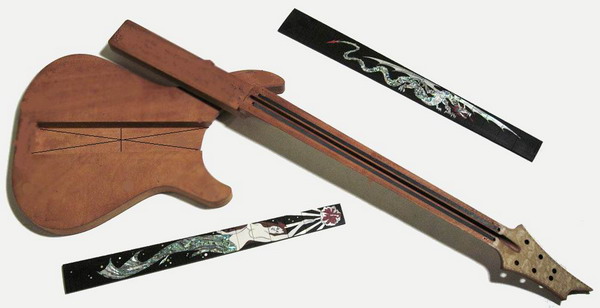
Above is my first attempt at designing the deep set neck tenon. Currently we have improved on it tremendously. We now add 6 dowels (3 per side) to get even better sustain & wood to wood contact. I cannot show the picture because it's a trade secret. If a competitor wants to find out how we do it they will have to cut one apart to find out. Notice the dual graphite rods in the neck on each side of the truss rod cavity.
A deep set neck tenon is an extremely stable way to build a guitar. It also helps the tone and sustain characteristics. Currently, we are carrying several brands of guitars that are built this way: Centurion, & now Quicksilver's are available in a deep set neck tenon.
How Guitars Are Usually Built.
Most archtop style guitars are built by taking a rectangular piece of Mahogany and laminating or "gluing" a rectangular piece of Maple to the top. Then the basic shape is cut out on a bandsaw and carved from that. Of course Mahogany and Maple are the common woods used, but guitar builders aren't necessarily limited to those two woods. I am just using them as an example for the sake of simplifying this explanation. For example, Gibson, Paul Reed Smith, and even my own Quicksilver guitars are constructed from rectangular laminated billets of wood. The Quicksilver's are now available with Deep Set Neck Tenon, They sound totally different from an original Quicksilver. We are also building them with a set neck and a neck thru body. We have to use completely different pickups with the set neck to get the guitar to sound as good.Very Few Guitars Are Constructed Differently.
The Centurion Guitars are all designed using a deep mortise and extra long neck tenon design. This would totally eliminate dead spots on a neck and give the guitar a tremendous amount of stability. This type of construction would also serve to add volume, tone, and incredible sustain. Centurion also makes a fitted archtop that gives them the ability to install the neck at the correct angle underneath it.
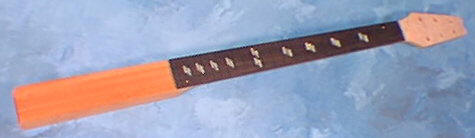
3/4 Deep-Set Neck Tenon
This idea in itself was not completely original. Other builders, such as, Grover Jackson, BC Rich, Alembic, myself, and even Gibson, with the Firebird, had built guitars with a neck-through body design. When Les Paul originally designed the SG, he had intended it to be a neck-through body. Of course, Gibson did not produce them that way. Gibson opted for the much less expensive set-neck style like the Les Paul or a PRS Custom. Les Paul & Gibson parted ways for most of the 60's because of Norlin's redesign of the SG neck (to this day the SG neck is considered to be one of the most unstable on the market. The first SG's 1961 actually were called Les Paul's however Les Paul wanted no part of that neck design and left Gibson.
Over the years, I have learned a lot of things from some of the industry's best and most innovative builders. People like Bernie Rico, Paul Reed Smith, Dean Zelinsky, Grover Jackson, and Joel Dantzig of Hamer, have proven themselves to be worthy mentors. For example, in my conversations with Joel Dantzig, I gained valuable insight regarding the construction of guitars. I questioned Joel about the reasons why Hamer never did a neck-through body. His answer was, "He didn't want to break the soundboard, tone-board, or the top of the guitar." The normal construction method for a neck-through body involves using a neck slightly longer than the one in the picture with glued-on "sides" or "wings" on each side. This method of construction does not lend itself well to an archtop because the main soundboard or "top" of the guitar is broken in half and separated by the neck itself.
How can this be prevented? Randy Curlee surmised the ultimate construction technique would be to have a neck-through body with a one piece top. Very few manufacturers offer this construction technique today. It comes on the Centurion and the Gledura guitars. We have done a few Quicksilvers that way but the Quicksilver is designed to be a cost effective guitar and come in for less money than a PRS.
Insurmountable Construction Problem
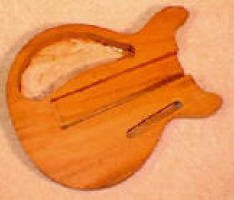 Q. How can you
get the 3/4 deep neck tenon set into an archtop style body?
Q. How can you
get the 3/4 deep neck tenon set into an archtop style body?
A. It simply can't be done using any normal or even computerized woodworking tools.
This of course means that PRS, Gibson, Ibanez, Jackson, BC Rich, Hamer, Fender, G&L, or any of the other mainstream companies will never do it. (It's way too expensive.)
To accomplish this feat you have to make a separate body and a separate top. (Twice as much work.) Then you have even more work to attach the two. First the pre-made body with a 12" mortise is attached to the vacuum table. Then the pre-made neck with the 12" tenon is fitted directly into the body. When that is all glued up, you then attach the pre-carved archtop directly to the guitar.
Abstract uses only quartersawn Maple, Korina, Mahogany or Premium Sapele for neck wood. Slab cutting (cutting the tree up into pancake style pieces) works well for tops, backs, and veneers; but, it simply isn't straight grained, strong or stable enough for a neck. If you ever see a guitar with quilted neck avoid it like the plague. No matter how pretty the wood is, I guarantee there will be huge problems with the neck.
IMPORTANT NECK INFO
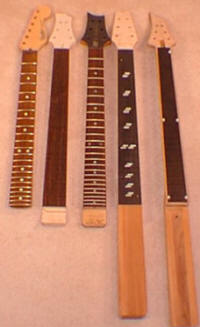
It doesn't take a college degree to see which neck design is the best. The Fender is a bolt-on neck. It attaches to a large flange that sticks out from the body. It was designed half a century ago and it is the hardest one to reach the top frets in the picture.
The Gibson Les Paul neck is not pictured here because I simply didn't have a loose one to photograph. (What you need to know...) The Gibson Les Paul neck is by far the shortest and stubbiest of all of them. It butts up against the guitar at only the 16th fret. The remaining 6 frets lay on top of the body. I personally hate that design. Look at a Les Paul from a side view. You will immediately notice how incredibly short the neck is. This neck was also designed 50 years ago. It's even harder than the Fender to reach the high frets. See Why They All Break
Guitars are available in a set-neck, bolt-in neck, and even deep-set neck tenon.
The Quicksilver & PRS necks are both designed in a similar fashion. The Quicksilver neck is improved because it employs a hard mount pickup cavity right in the neck; whereas, the PRS pickup only floats on springs above it.
PRS necks and Quicksilver necks are both 25" scale and they are completely interchangeable.
You Can Buy An Ed Roman Neck Click Here
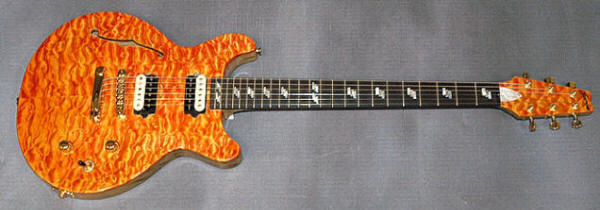
Look at this DC guitar The neck tenon actually extends to well below where the bridge and tailpiece are positioned. It is available in solid body, hollow body, or hollow body with an F hole. The F holes are available in many different styles. This guitar is our answer to Gibson's double cutaway guitar from the early 60's. Available in neck thru body construction |
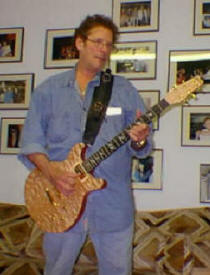
Leslie West with his Bluzeman.....
|
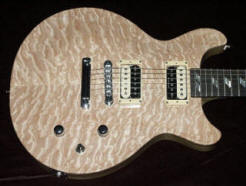
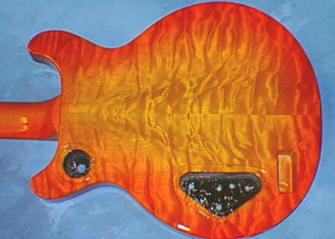 Quilted Back Option The Quilted back is now available on most of our guitars. This option from Alembic is $1,500.00 just for the back to match the front. PRS charges $1,700.00 additional for this option. But PRS includes the top also. I try to give my customers an education on what items cost
from some of the larger companies. |
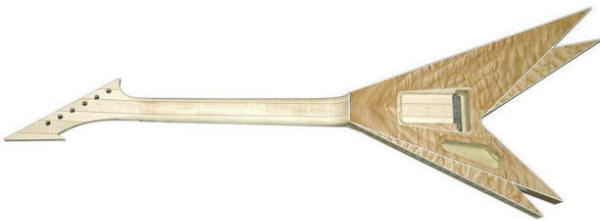
Notice the 5 piece super stable neck, you
can see it extending through the tremolo cavity.
The back and sides of this guitar are all quilted.
We could not do the neck in quilt because it would definitely break if we did.
|
Many Types of Neck Construction |
|
| Bolt-On | Cheapest to manufacture, it has a unique tonal capability and
is very
common. Not recommended because the heel is too big. The
design is very old and the neck joint is cumbersome. Tonal abilities
are excellent as long as the neck is a very tight fit.
(Sometimes you have to play 30 of them before you get one that sounds good.)
That will be the one
with the tight neck joint. Fender, Ibanez, G&L, ESP, Musicman, Washburn, Charvel, and most imported guitars. |
| Bolt-In | Excellent alternative to bolt-on. Same tonal ability, plus many of the set-neck abilities. Much more expensive, so very few companies offer it. Highly recommended because the heel is buried in the body. In fact, I highly recommend it over just a plain set-neck. (Works best acoustically coupled.) Currently no other companies have this except PRS & Quicksilver. Best for tone & sustain if the neck is tight & pickup is mounted directly in the cavity. (Call for information--(702) 597-0147) |
| Set-Neck | Less expensive and most common. I am not a fan of this one. Are millions of Les Pauls poorly designed and wrong? (A very Definite YES !!!!) Not recommended as highly due to limited tonal abilities. (Glue does not transfer sound well.) Plus, set-neck guitars are the ones that always break easily. Gibson, McInturff, Hamer, Warrior, Epiphone, Guild, Heritage, & many more. PRS went to this antiquated design in 2007 Ouch, Take a giant step backwards. Click Here For Details |
| Neck-Thru | Expensive and uncommon, I used to like this type the best until I
discovered Deep-Set Neck Tenon. (Pictured Below) Highly recommended, due to much more sustain, plus pickups are mounted right in the neck. BC Rich, Jackson, Rickenbacker, Jacobs, & Abstract. Quicksilver Now Available Neck Thru |
| Deep-Set Neck Tenon | Most expensive to do, but definitely the best sounding and the most cosmetically appealing. Very highly recommended due to same reasons as a neck-through, but with the added attraction of keeping the top intact. You may sacrifice some Strat and Tele tones but the blues tone is awesome. Rick Gledura, Centurion, & Quicksilver. |
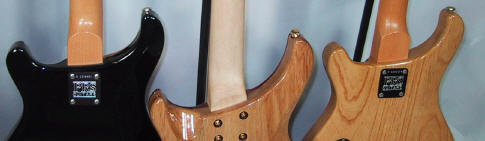
Quicksilver Neck Joint (middle) PRS Neck Joint (on each side)
It doesn't take a rocket scientist to see which one is the better one!
You Can Buy An Ed Roman Neck Click Here

Come To Las Vegas
There is nothing like this fabulous city anywhere in the world !!!
Las Vegas is Home to Ed Roman Guitars
Come Meet Ed Personally
Let Ed design you the custom guitar you have always wanted.
Big Money Guitar Designers
Being a guitar designer I am always looking for cool ideas, I recently found an incredible guitar designer from Switzerland. Claudio Pagelli, his guitars sell for $50.000.00 I saw one sell at Namm last year. Another amazing builder is Germany's Jerry Auerswald, Jerry's guitars sell for much less only about $40.000.00 each. Jerry is the guy who is building all those really cool "Prince Guitars" From what I'm told these guys only build one of each model guitar. I am lucky to Have an Auerswald guitar, I paid under $10,000.00 for it about 15 years ago.
I have put a few pictures below of some other
items designed by my all time favorite designer. Milano Italy's Luigi
Colani, He has never done a guitar but he has done almost everything else
from ladies shoes to Magnetic Levitation Trains, To Automobiles, To Urinals &
Bidet's, To Scissors, To Hovercraft. If you like his designs Google "Luigi
Colani" Prepare to be astounded
Ed
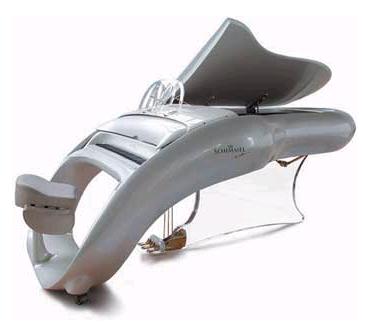
From Pianos To Cars To Urinals Colani
is my favorite designer!!
One of his famous quotes was
"There are no straight lines in the universe"
Ed Roman 2007
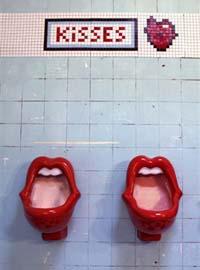
I am looking for cool Colani designs for my
collection of photos
Anyone who can help me. It would be appreciated
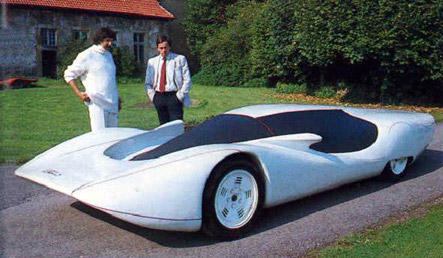
Colani BMW
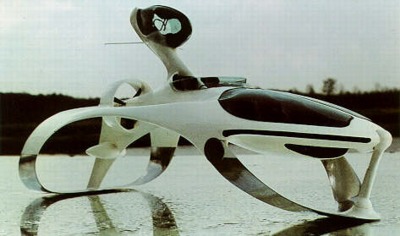
Hovercraft By Colani

Colani Horch
Horch were the original cars that the Nazi
officers used as staff cars
They changed their name for publicity reasons to Audi
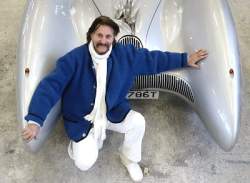
Luigi Colani Designer Extraordinaire
I would love to get him to design a guitar
Ed Roman
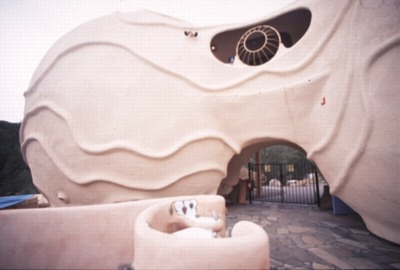
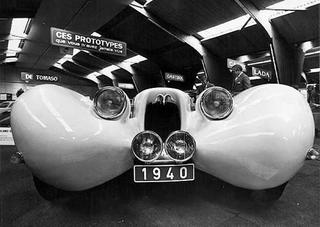
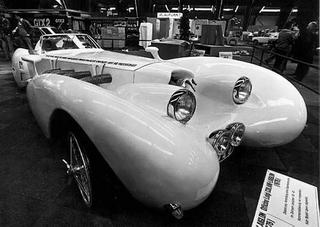
Laiglon by Colani
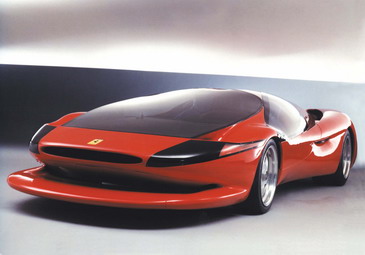
Colani Ferrari Experimental