Care and Cleaning of Your Guitar
Microfiber Polishing Cloths
These plush, soft microfiber cloths provide superior cleaning results. They contain no chemicals and are ideal for any fine musical instrument. They are in fact designed to eliminate the need for chemical cleaners.
Microfiber is a
synthetic fiber made of polyester and polamide. A single microfiber
is less than one hundredth the width of a strand of hair, yet when
woven together they provide a very soft surface with amazing
cleaning efficiency. These cloths are durable and can be washed up
to 500 times.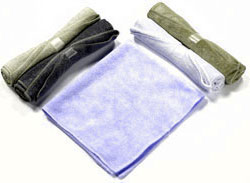
It is generally recommended that all Microfiber Polishing Cloths be machine washed with cold or warm water, using regular laundry detergent. To hand use liquid or bar soap. Microfiber Polishing Cloths may be air or machine dried. Do not use fabric softener or bleach and do not iron.
Microfiber Cloths: You are Never Too Old to Learn
People are constantly asking me, what should I do to polish and clean my guitar. I used to just say "Use a little lemon oil on the fingerboard and polish the finish with a clear non abrasive polish. Oh yeah, and make sure you use a clean dry polishing cloth.
Recently I instituted a new policy in the store. I told all the salesman that they had to carry a polishing cloths in their back pocket. This was supposed to ensure that all guitars were polished directly after anyone touched or played a guitar. This was part of my master plan to keep all the guitars in the store pristine looking.
Naturally, I had to carry a cloth myself. I had to polish the guitars the same as everyone else. Because of this I made an amazing discovery.
I happened to be polishing a black Heritage guitar about 1 week into the new policy. I noticed that the polishing cloth was putting small minor scratches in the lacquer finish. So I went to the showcase, I got a brand new Fender polishing cloth and tried that. I was surprised to see that the brand new, virgin, right out of the plastic Fender polishing cloth still left tiny scratches.
Being the Anal Retentive A$$hole that I know I can be, I decided to spend a little time researching cloth material to polish guitars with. I got on the internet and searched high and low for something that would be soft and durable enough to do the trick. My search led me to the Microfiber material that you will see below.
I am highly recommending this material as the absolute best cloth I have ever seen for polishing guitars with. I had to buy several thousand of them to be able to get a price low enough so that a guitar player would spend the money to buy one.
Ed Roman - 08/10/03
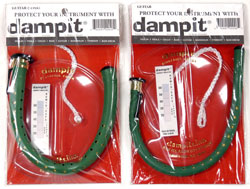
Dampit Guitar Humidifier
Ed Roman recommends the Dampit Guitar Humidifier for acoustic guitars. Soak the snake in water, squeeze out the excess. Put the snake in the guitar and cover the sound hole with the cover. Quickly quenches your instrument's thirst if you live in very dry climate.
For Nevada or other super dry desert climates, use the Super. For smaller instruments like Violins or for semi-arid climates, the Standard should be fine.
Herco Case Humidifier
Dry Climate:
Humidifiers are key to keeping your acoustic
in good condition if you live in a dry climate. Acoustic guitars can
and will shrink and/or crack when exposed to super dry climates,
like here in Las Vegas or other desert environments. If although,
you live in the desert and have had an acoustic for 10 years that
hasn't cracked, then you very likely won't need a humidifier to
protect it from cracking. You may be surprised though,
 what
restoring a bit of moisture to the wood will do for the tone of the
instrument.
what
restoring a bit of moisture to the wood will do for the tone of the
instrument.
If you store your instrument in its case this humidifier will be helpful. Submerse it in water for 5 minutes and wipe off excess, then store it in your case. Repeat twice a month. Works for guitars, violins, cellos, clarinets or any other fine wooden instrument.
Acoustic Guitar Care
Dry Climate: Humidifiers are key to keeping your acoustic in good condition if you live in a dry climate. Acoustic guitars can and will shrink and/or crack when exposed to super dry climates, like here in Las Vegas or other desert environments. If although, you live in the desert and have had an acoustic for 10 years that hasn't cracked, then you very likely won't need a humidifier to protect it from cracking. You may be surprised though, what restoring a bit of moisture to the wood will do for the tone of the instrument.
Buy a humidifier - Buy a humidifier - Buy a humidifier !!!!
The point of this message (buy a humidifier) is that if you're purchasing a new acoustic guitar (buy a humidifier) and you live in a dry climate (buy a humidifier), a humidifier will help protect the wood from shrinking and cracking. If you own an acoustic and live in a dry climate, buy a humidifier. We keep the entire shop at 45% humidity, which is just about ideal for wooden instruments, both acoustic and electric.
Humid Climate: High humidity causes wood to expand, which can affect the guitar in a number of ways. Bridges or bindings could possibly lift when humidity is extreme. I was born and raised in Florida, where strings begin to rust about two hours after you put them on. Keep your instrument and its strings wiped down in high humidity, this will keep your sweat and natural body acids from accumulating on the finish and eating it away, and especially help slow rusting of the strings.
Note: If you own a Taylor Guitar, make absolutely certain you purchase humidifier. Of all the acoustic brands I have ever sold I have had more problems with Taylor Guitars finish cracking than all other guitars put together. Taylor's are made in El Cajon California, just a stones throw from the Mexican border. Ed Roman recommends purchasing acoustic guitars manufactured in more humid climates, like the Pacific Northwest. Not the greatest idea to buy an Acoustic guitar manufactured in the dry Arizona, New Mexico, inland southern California climate.
Ed
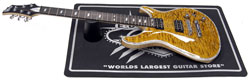 |
Fret Rest Cleaning & Setup SystemEd Roman fully recommends (read below) the Fret Rest system for the care and maintenance of your guitar. Pad and stand combine to create a stable workstation for restringing, cleaning or polishing, electronics work or any type of general maintenance. Full System and/or Replacement Pads. My Shop Uses the Fret/Rest System Exclusively!The system works great, the only real problem is because I have 12 repair stations the cost of the system is quite high. Recently I made a deal with a foam manufacturer to sell me replacement pads that were pre cut and matched to the Fret Rest system in large quantities. This greatly reduces my cost. The system neck rest hardly ever wears out and the plastic tubes are useless to me. By simply replacing the pad I can save about $1,200.00 a year in my shop alone. Plus, I have the added benefit of making a product available to my customers that they could not buy elsewhere!!!! In the old days when we built guitar benches we had to use carpet on the body rest area. We had to use shag carpet so that any iron filings or debris would fall deep into the crevices and not scratch a guitar. This was a real pain because we were constantly vacuuming and messing around with the carpet. Today the Fret/Rest closed cell foam padding is an easy to clean cheap alternative. When you are drilling and routing guitars like we do the pads take a real beating. Iron filings can destroy a pad with just one guitar repair. Because the replacement pads are available so cheaply we now can replace them weekly and still keep the expenses down. Ed |
Fingerboard Care Clayton Lemon Polish
If your fingerboard has become dried out from lack of humidity, or has built up grime from years of play, these products will clean it up and get it back to looking and sounding its best. Ed Roman recommends both of the fingerboard treatments in the Dunlop kit mentioned above, and also recommends pro lemon Instrument polish by Clayton, USA. Ed DOES NOT recommend using Finger Ease or any other string treatment. It gums up the fretboard and is unnecessary.
Dr. Duck's Ax/Wax
Recently, my good friend Steve Helgeson of Moonstone Guitars came to the Las Vegas shop for a visit. Actually, he was here to personally deliver the Viking, his latest hand-built creation for Ed Roman Guitars. We were walking through one of the showrooms and Steve noticed that I carry Dr. Duck's Ax/wax. Well, Steve was so enthused about the quality of this product that I sent a bottle to the shop so we could try it out.
It turns out that Dr. Duck works great on fretboards. It cleans the grime and restores the woods natural beauty. Ed Roman recommends Dr. Duck's AxWax, especially for your Rosewood fretboards, though it works well for Ebony as well.
Ed