|
The Fender Stratocaster is the best selling guitar in the world!
The choice of many working musicians just like Craftsman Tools.
When I set out to build a better one, I had several problems. These
problems were John Suhr, Tom Anderson, Gerard Melancon, Don Grosh,
Gary Levinson, Rudy Pensa, Roger Sadowsky and a host of others who are assembling super strats.
I say assembling because many of these companies don't actually build their
guitars. Many companies simply buy a neck and a body and assemble it and charge
ridiculous prices.
These people were already building Traditional type guitars that were heads and tails
better than anything any one else was doing.
I couldn't just build a better Fender, I had to build a better guitar
than the luthiers listed in the above paragraph.
I had to use better wood, better pickups, get even closer
tolerances, higher stability, offer more options, use better hardware, and do
better setups and because I was the new kid on the block I had to do it for less
money.
I believe this to be one of the primary reasons that the
Pearlcaster Guitar sounds better than most
other Fender
Clones.
At this time we are no longer the new kid on the block but
to my knowledge we are still doing it for less money.
|

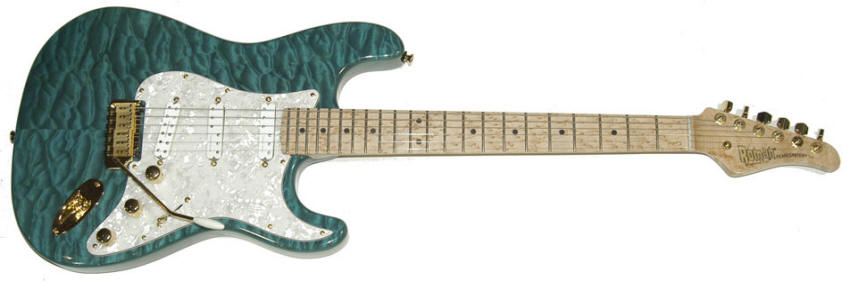
Pearlcaster
Ed Roman builds numerous different styles of guitars,
In fact I think I build more
different styles than any other small custom shop on the planet.

|
Important Guitar Facts
This page is dedicated to explaining what to look for in
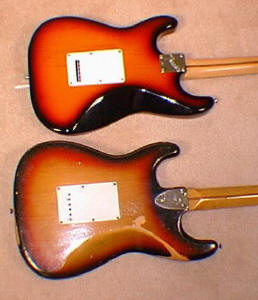
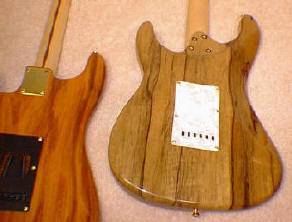
total guitar construction. You will notice two USA Stratocasters. The top one
is a 1997 American Std. Stratocaster the bottom one is an older 70's Strat. The
major difference between these two instruments is the material used in the basic
construction of the body.
The older ones pre 1990 are made from either Ash or Alder.
the ones made between 1990 and 1997 used Poplar a less costly wood.
The simple way for anyone to spot the differences are the
paint techniques employed on the backs of the guitars. You will notice the dark
edging on the new one is quite a bit wider than the older model. All the
contours are completely blacked out. This is done to camouflage the fact that
the body has a paper thin veneer of Alder or Ash. This veneer is harmful to the
overall tonality of the guitar.
The Glue that sits 1/64th of an inch
below the surface of the veneer acts as a tone dampener. Glue doesn't resonate
very well. Personally I don't approve of this method of guitar building unless
of course the guitar is being sold inexpensively.
|
|
This is a stock
American Std. Strat. (1992) It appears to be constructed of three
pieces of Poplar. There is absolutely nothing wrong with Poplar as a tone
wood, It actually resonates very nicely considering it's low cost. However
Poplar is a soft wood and it is porous and it is known to cause many finishing
problems. Fender used to get around this problem by using an unknown to me
filler material to the opaque finish models and veneering the translucent
models. According to Fenders legal department they are currently no longer using
Poplar.
The ones to look out for are made approximately between the years of 1990 and
1998. Fender has told me that they are not going to continue this practice on
their brand new models. |
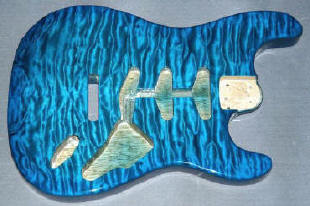
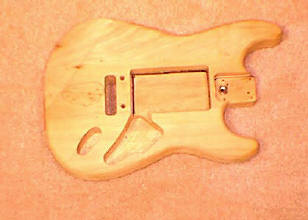
Stock Fender Raw USA Strat Body
Swimming Pool Route
|
The infamous notorious swimming pool route has
been a large detriment to Fender's credibility as a real guitar company. Many
young people are becoming disenchanted with the cheaper construction techniques
that are being employed today. Fender has made a major turnaround in the recent
years. The quality is at an all time high and the Mexican models are a great
buy.
There are also people that believe that the magnetic field
interference are reduced by the separate cavities. Fender takes the less costly
approach and routes out a swimming pool in the middle of the guitar. This
makes construction easier and a lot less expensive.
Some people actually argue that the quality of the wood is
not that important on Stratocasters. Because the pickups aren't attached to the
wood but actually suspended and spring loaded to a plastic pickguard.
I personally don't believe there is anything wrong
with this method of mounting pickups. I personally prefer to
mount them solidly to wood. But to achieve that Thin, Vintage Fender
signature tonality, I believe pickups should be hung in cavities.
Below are some bodies that I fabricated in my
custom shop. I have decided not to take any chances. So I am using ultra high
quality tone wood and I am true to the original Fender 50's design of separate
pickup cavities. So if you already own an American Standard, Deluxe Plus,
Deluxe or Ultra Fender Stratocaster I submit to you I can help you improve the
tonal quality of your guitar.
|
ALL ACCESS NECK JOINT

I don't just dedicate my efforts to tonal improvements,
I also stress playability.
What good is a great sounding guitar if you can't
play it easily.
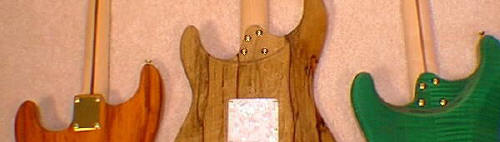
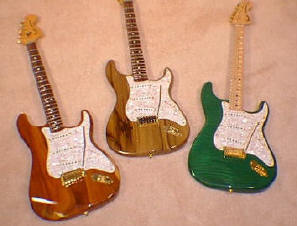
The Koa model above and below left, is built in the traditional Fender
format.
The Korina model in the middle and the Flame Maple model on the right
sport my trademarked
All access neck joint TM.
These 3 Stratocasters Have Been Improved a Number of Ways
-
Tonally: By using high quality highly resonant
tone wood
-
Tonally: By adhering to the original pickup cavity configuration
-
Tonally: By total elimination of glues
and fillers
-
Tonally: By the addition of higher quality better sounding pickups
-
Playability: The "All Access Neck Joint" TM
-
Playability: The original Fender necks are all custom re shaped
to the player's hand
-
Playability: The tremolo systems are replaced
-
Playability: Frets are all redressed and polished
-
Playability: necks are all given the
1500 G modification
-
Cosmetically: The finishes are beautiful
-
Cosmetically: The color choices are limited only by your imagination
-
Cosmetically: Every single screw is replaced with high quality gold
plated ones
-
Cosmetically: Pick guards are replaced with higher quality Latrinium
-
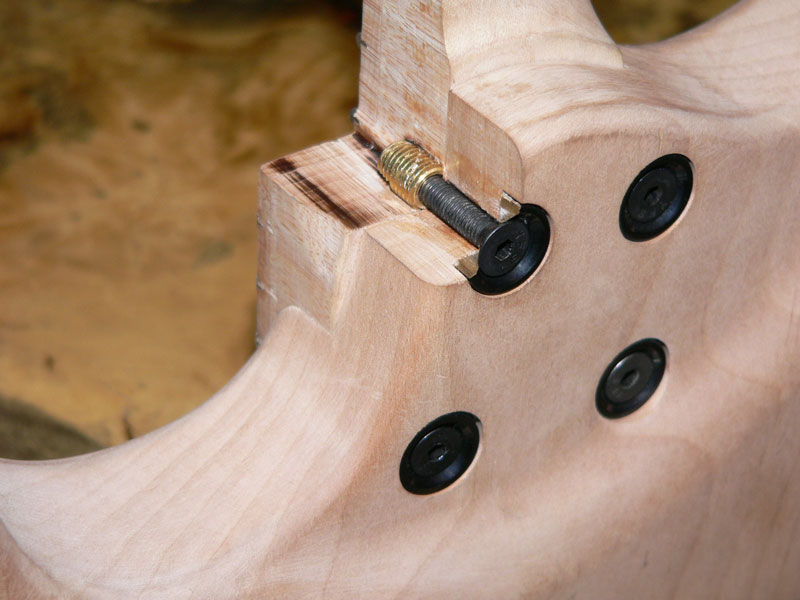
New in 2006: All Necks are torqued on to the
body with our exclusive brass inserts
Ed Roman's Brass Insert System For Better
Stability
It actually costs less to glue in a neck than to bolt one in
correctly. Gluing
up a neck is pretty basic. You apply glue inside the neck joint, slide the neck
in and clamp it down. A bolt in neck requires a lot more work, there is no room
for a sloppy fit like on a glue in neck. The cost of stainless bolts and press
fittings are far higher than the cost of a little glue. The labor factor
requires 4 holes drilled and countersunk. The tolerances are extremely tight on
a good bolt on neck where the tolerances are far less important with the
application of glue. If you make a mistake and drill incorrectly it’s time to
throw away the body. On a glued up neck there are no holes to drill and less
chances of a mistake.
I know, I know it’s been done that way for 60 years! why change now? Why
not keep our heads buried in the sand & continue thinking like we did in the
50’s & 60’s ?
Any luthier will tell you that the neck breakage occurs more on set neck guitars
than all other guitars combined. The fact is I have repaired less than 15 bolt
on necks in 32 years. I have repaired well over 3000 set necks and at any given
time there are probably at least 6 of them broken in my shop.
First of all there is absolutely nothing wrong with a bolt on or bolt in neck as
long as it’s done right. I must stress the part about it being done right !!!!!
The glue between the neck & body of a guitar will prevent 60% to 70% of high end
tone transference. For example, try to get a funky nasal ducktone twang on a
glued in neck guitar. It won’t happen.
Bolt on necks originally got their bad reputation during the 70’s when companies were
making them with ill fitting or loose neck joints. A loose neck joint causes
instability and detracts horribly from tone quality. A loose neck joint will
also cause tremendous loss of sustain. Some companies in the 70’s were mass
producing guitars as fast as they could and were simply not paying attention to
the neck joint! The necks were not fitted correctly and in many cases the
strings were actually hanging off the edge of the neck.
A lot of criticism is leveled at the 3 screw neck mounting plates of the era.
Personally I like the concept of the tilting neck which of course is only
available with a three bolt neckplate.
Thanks to modern machinery and woodworking techniques neck joints are a lot
better & tighter today. We now know much more about guitar construction than we
used to. Guitars in general are a lot better today, even the Mexican ones are
better than some of those USA guitars from the 90’s. A tight neck joint equals a
good guitar !!!
The neck joint is the heart of the guitar, If the neck joint is set up properly
the guitar WILL always sound better.
In my shop we make it a rule to mount each neck so tightly that it’s almost a
force fit. The technician should be able to physically pick up the guitar by the
neck so that the body is suspended and the fit alone should be enough to hold
the body to the neck.
My sure fire test is to take a thin guitar pick and try to slide it between the
neck and the body. If I can get the pick into the crack then I know the guitar
will be lacking in tone & sustain.
Synopsis
Bolt On Vs. Bolt In
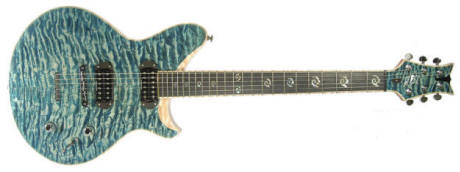
Both ways work very well as long as you get a tight neck fit. The bolt in like
the Quicksilver is superior because there is no protruding flange to bolt the
neck onto. The neck actually bolts in through the back of the guitar.
Consequently you get better stability, even more tone & sustain and as an added
bonus you can reach higher up the neck. More notes, more better sounding notes
!!!!
|