Facts Fallacies & Falsehoods
| A Guaranteed Sure Fire Way
To Tell The Real From The Rip-off's |
"Read the whole page for the answer"
)))))) IMPORTANT (((((((
A
copy of a guitar is not necessarily a forgery unless the person selling it to you
tells you it's real"
Vintage Guitars: A good investment or a sucker's bet??
Read this page before you buy an expensive overpriced
vintage instrument.
| Disclaimer
All guitars in my inventory that
are sold as vintage will be approximately 25 years old or older. Ed
Roman guarantees they are all what we say they are. If any guitar
turns out to be a copy or forgery, Ed Roman will buy it back no time
limit involved. If the guitar in question turns out to be a 1956 and
It was advertised as a 1958 that is not grounds for a return. Ed
Roman will make every attempt to try and get the year correct in the
description but sometimes it is impossible to be 100% sure.
Click here for our Vintage Guitars For Sale
|
|
Evil
Manufacturer Profiteering
Imagine,
if you will....
What If, any guitar
manufacturer wanted to profit from the Vintage Craze of the early
90's?
I mean all the dealers are
getting rich doing it... so why shouldn't the manufacturers get a
nice slice of that pie?????
(tongue in cheek)
They could simply, reissue copies of their old
guitars for 3 to 4 times the price of their normal guitars. Selling
them fully knowing that it would be very easy to forge and
artificially age.
The people who buy them for such ridiculously
high prices could easily turn these into what appears to be original
vintage guitars. They could then easily sell these forged guitars
for an even bigger profit to one of those more-money-than-brains
types who thinks he is buying a real vintage guitar. I am not making
any accusations, I am simply pointing out.
What If...........
As a guitar manufacturer myself, I am keenly
aware of what it actually costs to manufacture a guitar both by hand
& by machinery. If I decided to reissue my original Quicksilver
model, it might cost me ever so slightly more to build than the ones
I am building today. The difference in manufacturing cost is so
negligible, that it doesn't merit any real price increase.
As a guitar builder, It would make sense to me
that if the public wanted the old style cosmetics, why not build all
the guitars that way. I think it is unfair profiteering for a
company to charge $3,500.00 or more for a guitar that costs the same
to build as the one that sells for $1,400.00 which is usually
already over inflated.
Be aware, today a custom made guitar is no
longer considered expensive!!!!
Due to the ridiculous perceived value of
guitars, that all of the major companies are peddling. These
corporate bean-counter suits are selling production, machine made
and imported guitars, for such high markups!! That it has finally
leveled the field for hand builders like us.
Today you can come to a builder like us, and
get a complete & total custom made guitar, built exactly the way you
want it, usually for about the same price as buying a production
made model.
Ed Roman 01/24/04 |
Other Forgeries
|
When purchasing an old guitar you must be very careful, There
are a lot of FORGERIES.
There are many types of forgery guitars on the market. Some of
them are done on purpose and many of them are done innocently and
unsuspectingly by their owners.
About 11 years ago a good friend of mine decided to sell his early
Les Paul. This guitar was a very rare example of a Les Paul because
of the color and the quilted top. He has owned this guitar for
almost 20 years so both of us are certain that the guitar is
authentic, however over the years he had made a number of changes to
the guitar. He swapped out one of the original PAF pickups for a
Dimarzio in the 70's, He changed the nut to brass in the 70's. He
replaced several of the pots in the 80's and in the 90's he had to
replace the bridge. Luckily he never did anything with the tuning
pegs or it would have been a major problem, because holes would have
been drilled.
He brings the guitar to me because he wants to buy a really
cool new guitar. He tells me he wants to get strong money. I told
him that no one would pay what he wanted with all those changes. So
he now wants to put the guitar back to original.
(this happens
all the time). When this guitar is all rebuilt no one not even
me will be able to tell the difference. Anyone who is foolish
enough to make a statement like "They can't fool me" or "I can
always tell" is living in a fools paradise.
I have been going to "Vintage" guitar shows for about 21
years. It seems to me that there are many more guitars available
today to buy than there were 16 years ago. How can that be? I mean
how is it possible for dealers to have 15 to 20 vintage Strats in
1999, when in 1991 there were only a few to be found. What's up
with that!!! |
Ed Roman has
several theories
| 1. Are these guitars magically materializing at tag sales? (Yeah Right)
2.
Did these
guitars bring so much money back in the early 90's that it made sense to start counterfeiting them?
3.
Did forgers & eBay maggots buy factory reissue guitars and
artificially age them so they would look like old guitars? |
I suspect that #2 is
definitely much more likely than #1, And you can believe me many of those Vintage Guitar Dealers already
know exactly what I am telling you. I can also tell you they turn a
deaf ear to it and try to pretend that it's not really happening.
As for #3, I strongly believe, that
several large companies have fueled the illegal flame by putting out
stupidly overpriced reissues to appeal to the forger.
It has come to my attention that there is a large cottage
industry in Japan, Korea, Taiwan and even the Philippines that
re-manufacture Gibson parts, Fender parts and even completely
counterfeit 50's & 60's complete Fender Guitars. I remember 25
years ago a company in the Philippines was producing a guitar that
was almost exactly like a Stratocaster. It had Fenders Logo and
patent numbers on the tremolo plate and it even had the big reverse
"F" logo on the Tremolo cover plate (I have never seen a stock
Fender look like this).
Recently I accidentally acquired some instruments that looked
so close to the original models that I started to suspect that
companies like Tokai were actually building the original instruments
for many of the major corporations. I did some investigating
and I found a company called Skye manufacturing in Korea was
shipping thousands of Humbucking pickups to a large well known
supposedly American guitar company. These pickups were shipped
FOB Seoul Korea at $2.10 each. including a chrome cover. I actually
have a copy of the invoice and I will show it to anyone who asks if
they are at my store. I also have a copy of the Bill of
Lading, customs declarations and even a signature on the bill of
lading that the pickups were received.

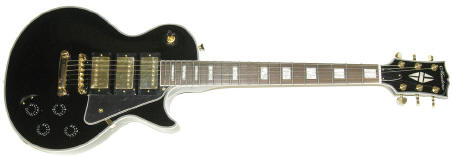
I got into a 3 year lawsuit, with Gibson Guitar
company regarding some guitars I received that were exact copies
right down to the trussrod covers, Headstock shape and decorative
logo. There were only 16 of them and I will gladly show anyone an actual
guitar.
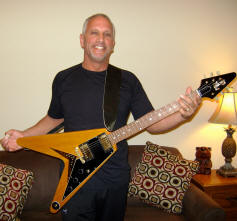
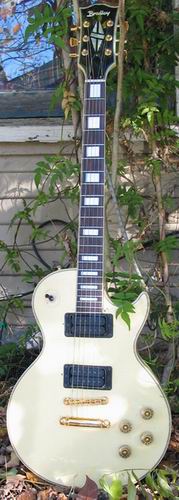
If you can tell it apart from the original model I
will be very surprised because I cannot. The picture above
looks like rosewood, I can assure you it's actually real ebony with
real Mother of Pearl Inlays. The only difference
is the name brand and it's inlaid with the same material and the
same font as the original. Now I'm not just talking about
cosmetics here. These are the same guitars or I'll eat my hat. I
bought 16 of them from an American importer who had them drop
shipped out of Canada direct to me. Now get this. I paid the
meager price of $362.00 each including all freight costs from Korea
and presumably a 20 or 30 dollar markup from each of the 2 importers
who handled the guitars. Dealer cost on the exact guitar with
the famous name on it is over $2,300.00 not what the customer pays
mind you. that's what the dealer pays. Presumably the
customer pays close to $ 2,700.00 per guitar. what a ripoff
!!!!
When
I bought these guitars I had no idea that they would be EXACT
copies, I assumed incorrectly that I was getting the standard look
alike guitars that I had been buying from him for many years. They
were close but there would have been no lawsuit, because there were
enough minor differences where Gibson didn't care.
Looking back at the situation I should have returned the guitars
when I got them But I was afraid that the importer in Canada would
have stiffed me for the cost of the guitars. I'll be careful never
to let this happen again.
This lawsuit with Gibson wasn't a problem for me because I was
insured to the hilt for just such an eventuality. I am very careful
to insure myself for malicious and frivolous lawsuits. Meanwhile
Gibson has expended well above $600.000.00 or more maybe much more
on a useless pecker contest.
They could have simply called me and I would have dismantled the
guitars and sold them for parts. I always try to cooperate with
companies when it comes to matters of Intellectual property.
Over the past 10 years I have been offered almost every part
imaginable. PAF pickups, complete with sticker and authentic
cigarette smoke mildew smell. Fender Jazzmaster tailpieces complete
with Fender Logos and patent numbers, Strat and Tele necks complete
with authentic stamp and signatures, Pick guards with 60's dated
authentic stickers. At the Fall Philly 1997 show there was actually
a guy walking around with Fender neck plates complete with the
original die marks on the holes. He would actually make any plate
with any number you want he was even giving out a phone number (that
is rare). Usually these people want you to buy the items on the
spot, pay cash and then they quietly disappear. There was also a
guy who had a whole table of decals, I swear this guy had every
single obscure decal that Fender ever made. I have since heard that
Fender sued him and now he no longer goes to the guitar shows, But
I would bet anything you can still buy them from him somehow.
In 1995 I personally was in a small dimly lit room where I
witnessed 8 Japanese nationals working on 9 tables recreating
Fender guitars. These guitars were accurate in every way. These
guitars were being signed inside, serial numbers, stickers and
decals were being meticulously applied and there was even an ultra
violet system to age the lacquer. There was classical music playing
and no one spoke a word while I was there. I had the distinct
feeling that these people did not speak English.
I have been around electric guitars since 1964, well over 35 years, and I could absolutely not tell if these guitars were real or
fake. Anyone who could tell would have my deepest respect.
There is a local Trunk Gypsy* (Guitar guy who works out of
his car) who I guess is more knowledgeable than me. He has told
me several times that "He could easily tell the difference between
a real PAF pickup and one of the imitations." He was recently in my
shop. He was buying some Original Fender bodies from me. (Hmmm I
wonder why). He happened to have a pair of what seemed to be
original PAF pickups. He told me he had "Scapped them out of a
'61 SG that he bought for $300.00." His exact words. I asked him
what he replaced them with? He replied that he aged some stock
Gibson pickups and was going to sell it that way. He wasn't trying
to sell me the pickups. We were just talking. I had in my
possession a PAF copy that I presume was Asian made because I bought
it from a nameless Oriental gentleman for $100.00. I told him that
this pickup was presumably not real. I told him I had acquired it
for a customer who wanted to put his Les Paul back to semi original
condition for the purpose of selling it. He became defensive about
his pickups, Claiming to me that his were real. I had never made
mention of his being real or fake, he just became defensive for no
apparent reason. The pickups were virtually identical in every way,
The sticker was right, etc. I said to him let me see yours, let me
hold them both in my hands at the same time, I would like to know
how you could tell the difference. (Well of course that never
happened)
Incidentally a pickup, any pickup costs less than two ($2.00)
dollars to manufacture. Do the math 35 cents for a little wire, 33
cents for a plastic bobbin, and 6 magnets that are probably less
than a nickel each. All you need is a $600.00 winding machine. I
will bet money that the packaging on a new Gibson pickup costs more
than the pickup costs to manufacture. All the cost is for the
advertising, endorser royalties and packaging. |
My point here is very simple.
(YOU CAN NEVER BE TOO CAREFUL)
Here Comes The Payoff
| The next piece of information I am going to tell you. Is
probably the only sure fire way you can tell if a guitar is real. This information may sound a little off the wall at first, but when
you think about it for 30 seconds, it doesn't take too much
brain power to see that,
I have to be
right !!!!
So Here Goes:
The only way sure-fire guaranteed way to know if a Vintage
Instrument (or anything for that matter) is truly original
and unchanged is if you purchase it from someone who does NOT know
the value of it. The minute the value of the instrument enters into
the pricing equation then the chance of originality is tainted.
This does not hold true on lower cost Vintage Instruments
because there would be no reason for someone to go to the trouble
and cost of recreating it. For example a Dan Armstrong guitar would
be more likely to be original than say a 62 Stratocaster because
replacement parts are simply not available cheap. A
Mosrite would cost more money
to reproduce than it could fetch. But a 1962 Stratocaster could
easily be accurately reproduced for less than $500.00 and even in
today's waning Vintage market still fetch $13,500.00 easily.
(Update: Mosrite prices have
now gotten high and there are many fake Mosrites out there.)
Remember if the value far exceeds the cost like a 1962 $180.00 (list price when new) Stratocaster selling for
$17,500.00. Compared to an old Stratocaster at a tag sale or from
Grandma's Attic for $100.00. I would bet money that in almost every
case Grandma's $100.00 one was actually more original than the
$17,500.00 one.
It's just as easy for a counterfeiter to make fake $50.00
bills as it would be to make fake $1.00 bills. Which one do you think he
is going to make.
|
|
Fun Questions
to Ask
My shop alone did at least 2000 brass nut conversions in the
70's.
I ask you: Where did those all go?
(I can't remember seeing a brass nut anywhere for almost 20
years)
My shop used to sell over 200 (low estimate) Dimarzio
pickups a month during the 70's. Most of them went into Les Paul's
and Strats. (Seymour Duncan
Pickups were not available then)
I ask you: Where are they now?
What happened to all those original pickups.
(I used to toss them in the
garbage) They never did sound that
great and nobody wanted to buy them. I remember my wife tossing out
a whole box of them.
Today I have at least 400 sets of PRS pickups that I removed
from new & used PRS guitars in the last 5 years. No I am not
throwing them away!!! Just because I was stupid once
doesn't mean I'm still stupid. Currently no one wants them so maybe
I'll hold on to them for several decades and see if people are still
as stupid as they are today. I have a $1,177.00 dollar Craftsman
Toolbox sitting chock full of PRS pickups. Currently (1997) the toolbox is
more valuable than the pickups.
I have been going to guitar shows for many years, I remember
going to shows in the late 80's and early 90's the few dealers who
were present had very few old Fenders and Gibsons. Now when I go I
see many dealers with over 25 Vintage Strats alone.
I ask you: Where did all those older
guitars come from???
My shop alone did well over 1000 Floyd Rose Conversions on
Stratocasters, Les Paul's, SG's, and once even a 1983 Moderne.
(I only mentioned the Moderne because we did the conversion for a
person who today is a large vintage dealer himself. I usually rib
him about it every time I see him)
I ask you: When was the last time you
saw one of these guitars anywhere?
What could have happened to them?
Think About It !!!!
)))))) IMPORTANT (((((((
"A copy of a guitar is not a Forgery unless the person selling it
to you tells you it's real" Be EXTRA careful when a dealer
says he doesn't know the history of a guitar. This is a way of protecting himself if the guitar is bogus or
fake. Sometimes a dealer will tell you the guitar is on consignment. When in fact he may own it outright. In this way he escapes any responsibility if you find out it's
bogus later.
As people get older the guitars
that become valuable are the ones that were played 20 to 25 years
back.
Hello Ed Roman,
I'm beginning to think that fake vintage guitars
are actually better than real vintage guitars. The real vintage
guitars I've seen are heavy, have clubby thick necks, have noisy
switches, are buzzy, and have faded pickups. The new fake vintage
guitars I've seen are lighter weight, have easier to play necks, new
switches, have new louder pickups, and seem to be assembled better.
The mint condition vintage guitars I've seen are
mint because they weren't playable and/or didn't sound very good -
so they didn't get played all those years. The beat up worn out
vintage guitars I've seen are the ones that were built right and did
sound great so they were played all those years.
Andrew
A Great Letter from Duke Seino
For all you rock/alt rock Fender / Gibson / Epiphone / Marshall / PRS Nazis: You know you who you are… The
people that think that these are the ONLY guitars you should play to
be "cool"… Open your minds to the great new independent guitar
builders… They care more about their craft than the “bottom line”
just like your “favorite” bands did before they “sold out”…
I hear everybody complain about how mainstream
music sucks and how we should always listen to the new bands and
artists that radio won’t play…By this same logic, shouldn’t you play
a great guitar that is NOT the run of the mill mainstream brand???
It is very likely that your favorite guitar
companies HAVE ALREADY SOLD OUT!!!!
Duke Seino, tone junkie
Now click this and open your
mind
|
|
|
10 Reasons
Why Vintage Guitars are Not Worth the Money.
This Is a
Reprint of someone else's article
This is Not a Direct Ed Roman rant
I agree with it in principal but not entirely !!!!
1. Modern
guitars are made exactly the same way that vintage guitars were
made in the old days.
I think the roots of the whole "vintage" guitar movement began
when Martin couldn’t get large pieces of Brazilian rosewood in
the mid-60’s and switched to Indian Rosewood, which isn’t as
pretty. Any luthier will tell you that if you make your
instrument out of good hardwood and you know what you are doing,
it’s going to sound decent. However, what a lot of people DON’T
KNOW is that there is a balance between sturdiness or
functionality and sound. The thinner the top, the more it will
vibrate and the louder and fuller the sound will be. However,
you don’t want half of your guitars returned to you because the
tops split or the sides or backs cracked. Making the tops
thicker makes them sturdier but also causes them not to sound as
good. Every manufacturer of acoustic instruments has to confront
this reality. The manufacturer is in the business to make money.
When Martin decided to drop Brazilian rosewood, it was a
business decision. The wood just wasn’t available so they had to
go with "plan B". I’m sure Martin didn’t think that their
guitars were then crap because they had to change suppliers. I’m
sure they did the best they could and sought out the best wood
they could find. I’m also sure that Martin was at that time and
still is the best acoustic guitar company in the world. However,
as a result of this decision to got to another type of rosewood
and another decision in which guitar backs became 3 piece
instead of the traditional 2 piece, the ignorati of the time
began to badmouth Martin and suggest that the new guitars were
inferior. This is the very earliest reference I can recall to
the idea that guitars somehow could be "vintage" or have good
years and bad years.
I would have to agree
with this except that the older guitars were much more hand made
than today's guitars. That isn't necessarily a bad thing but it
is a fact.
Ed
The mid-60’s was the beginning of the explosion of popular music
throughout America. The demand for musical instruments was
beginning to grow exponentially. If you needed to go from making
500 guitars a month to 2000, you have to make changes! The CBS
corporation bought Fender and needed to up the production
numbers dramatically. A lot of changes in manufacture were
necessary to expedite the manufacturing process. By the end of
the 60’s Fender wanted to eliminate a step in the set up of
their guitars by designing the infamous "3 bolt neck". The 3
bolt design allowed the neck angle to be adjusted without the
complete disassembly of the neck and the body. More guitars
needed to roll down the assembly line so that more could be sold
and keep the stockholders happy. Polyurethane paint replaced
nitrocellulose lacquer because it was much easier and quicker to
complete a guitar. Sure, some of these changes turned out to be
bad ideas! However, nearly across the board, manufacturers
responded to consumers complaints and worries by returning to
older, more quality conscious designs. Martin was making a
reissue of their "herringbone" D-28 with scalloped bracing very
early on. Fender and Gibson started reissuing classic models in
the 1980’s! There may have been a time (the 1970’) especially
for Fender, when the older guitars were probably better made.
But this was a relatively short period of time. Manufacturers
rapidly responded to public demand and began making their
instruments the old fashioned way. I’m surprised that they don’t
get more credit for that! Sure, large pieces of Brazilian
rosewood are in short supply, but 98% of the other woods and
materials used in the 40's and 50's is still available.
People like to believe the myth that the guitar they own is
somehow special and rare. I remember that collectors were always
going on about the "flame maple" on the tops of the Les Paul
Standard sunbursts from the late 50’s. It’s kind of funny when
you think about the fact that Gibson obviously got the idea from
the BACK of violins which had been made with book-matched maple
for hundreds of years. The flame maple is completely decorative.
There is nothing about flame maple that makes it superior to
regular maple. It was a cool idea and it looks great unless the
man at Gibson assembling the top decided he didn’t want to spend
much time trying to match the wood up. It was fairly common to
see that one half of some of the tops would look much flamier
than the other half and some had no flame at all. Collectors
zeroed in on flame maple like it was Viagra and they were all 80
years old. Guys would pay 3 times as much for a guitar with a
particularly nice, balanced flamed top. It was common to hear
the opinion that Gibson stopped doing this because "the wood was
no longer available"; "it was all used up", etc. Of course,
nowadays you see it everywhere. Paul Reed Smith doesn’t seem to
have much trouble getting it for his guitars and even Gibson
must have discovered a mother lode of it judging by the amount
of super flamed Les Pauls it’s been pumping out for the past 20
years. Apparently, when the guitar was being manufactured, it
couldn’t have been all that popular because Gibson dropped it
from their line for SEVEN YEARS and made what we now call the SG
bodied guitars as their primary solid body. My guess was that
players had the same complaint back in 1959 and 1960 that they
have today- the guitar tends to be too heavy. I don’t think it
was dropped because they ran out of flamed maple!!
In many ways, the materials available today are superior. The
plastic in pickguards and pick-up covers is better made today
for example. The old Bakelite would crack and discolor. The
original Strat pick up covers from 1954 to 1956 broke so often
that Fender stopped using the material. Anybody trying to twist
a "vintage" plastic tuning peg has to say a Hail Mary so the
damn thing doesn’t break off in their fingers. There's a good
reason that Grover tuners were the rage in the 1960's and were
almost de facto on your Les Paul Standard at that time. It's
because the original pegs were pretty cheap. If you bought a Les
Paul Custom, which was a lot more money, Gibson threw in the
gold Grovers, but the stock pegs were really lame in many cases.
Tuning pegs on today's quality guitars are far superior.
Electronics of today are light years ahead of the stuff from the
1950's. Sure, for the most part, a pick-up is a pick-up. It's
hard to be innovative with what is essentially a magnet with
copper wire around it! The law of diminishing returns starts to
apply. A humbucker is a very simple device. It was wonderfully
designed and improvements on it are possible but the results
will be negligible. HOWEVER! I am sick to death of morons
telling me that PAF's from the 50's sound better than modern
humbucking pick-ups. That's just a lie. Anybody who knows
anything about guitar electronics will tell you that the sound
of a guitar is not produced by the pick-up. The pick-up is
merely an amplifier. What you hear coming out of your amp is the
sound of the guitar AMPLIFIED by the pick-up. So if the guitar
sounds dead, doesn't sustain and has flat wound strings on it,
guess what? The guitar may sound like crap. The PAF's aren’t
going to override the guitar and magically make it sound like
Eric Clapton on the Bluesbreakers records!
In the early days of vintage guitars, before all this stupidity
took over, we would swap the PAF's in our Flying V's, sunbursts
and gold tops trying to see if we could find some holy grail
pick-up. The thing I immediately noticed was that a set of PAF's
would sound a little different in every guitar. In some it would
sound amazing and in others it would just sound average.
Obviously, the pick-ups are only one factor in the sound of a
guitar. If the guitar sounded average or bad with one set of
PAF's, it tended to sound average or bad with a set of PAF's
from another guitar. When I say "bad" I mean subtle differences
like high end frequencies and sustain. We wanted a lot of treble
and endless sustain. Some guitars just wouldn’t do it no matter
how many pick-ups we'd stick in it. So people need to get over
this attitude that PAF's are somehow superior. PAF's are no
better than the Korean pick-ups in the Les Paul hanging right
now at your local music store.
Anybody that doesn't believe me should accept my $10,000.00
challenge. Just bring your stock 1950's Les Paul to your
favorite music store. I'll pick the amp and I'll take down 3 new
Les Pauls off the store wall. Then I'll plug in while you stand
20 feet away with a blindfold on. You have to pick your guitar
out of the 4 when I play it. If you can't identify it repeatedly
with any true certainty, I keep your guitar. If you can always
tell which one is yours, you get $10,000.00! It should be easy
to do because you think the PAF’s in your old guitar sound
"better", right?
Let's talk about your 3 most valuable collector's items. The Les
Paul, the Strat and the Martin D-45. The Les Paul Standard from
the 50's as we all know, has a maple top (except for the
Custom), mahogany back, sides and neck, two pick-ups, 4 control
knobs, some volume and tone potentiometers, stop tailpiece,
tune-o-matic bridge, a toggle switch, an input jack, some switch
and control covers on the back and a rosewood fretboard. Around
1955 the bar tailpiece was replaced by the "tune-o-matic" bridge
and by 1957, Gibson had refined that guitar by introducing
humbucking pick-ups but it has essentially remained unchanged in
design since 1952. In 1959 Gibson wisely went to a larger fret
wire and Voila, the guitar graduated and has been made EXACTLY
the same except for decorative cosmetic changes ever since.
Sure, Gibson went to multi-piece bodies on their Les Pauls for a
while which pissed off the purists, but once again, by 1968 they
responded to market pressure and made a really nice copy of a
1950's gold top with a one piece body and the old "soap bar"
pick-ups.
In 1954, Fender brought out the Strat with an ash body, maple
neck, plastic pick-guard, 3 pick-ups, selector switch, and
tremolo bridge. The changes on the Strat over time were even
less dramatic than the Les Paul. All Fender changed for the
first 4 years was the shape of the holes on the tremolo cover,
the pick-up cover material and the paint from two color two 3
color sunburst. Later years saw the advent of the rosewood
fingerboard, multi-laminate pickguards and by 1965, plastic
fingerboard markers and by 1966, a bigger headstock. Fender
makes an EXACT copy of their 1954 Strat as we all know along
with many other "vintage" designs culminating with the
ridiculous "relic" series in which you are paying the
manufacture of your new guitar to beat it up enough to make it
look old. And you pay EXTRA for that! Please don’t spend the
extra money to buy a "Relic". Just get a new one, gig hard with
it and in no time it will become a "Relic" free of charge.
At the end of the 30's, CF Martin introduced a remarkable
large new style guitar they christened (no pun intended) the
D-45. They gave the first one to Gene Autry and put his name on
it. The first few had twelve frets to the body and a slotted
headstock. Later ones had a western style, unslotted headstock
and 14 frets to the body. This guitar evolved far less than
either the Strat or the Les Paul. I believe less than a hundred
were made in the 30's and 40's. But by the 1980's, you could buy
an exact copy of the first one made complete with Gene Autry's
name on it.
These are not 16th century hand made Cremona violins. They are
mass produced, machine made commodities. A Les Paul or a Strat
probably takes 10 hours to make. If they didn't have to wait for
the paint to dry, they could probably make them in 5 hours.
I disagree They take
less than an hour to make and the paint dries instantaneously
sometimes less than 3 minutes
Ed
So you have to ask yourself a question. Why the hell
would I want to own an original 1954 Strat when I can go buy the
exact same guitar in better condition with a warranty at my
local music store for about one percent of the price of a 1954?
Why would I want to buy a 1959 Les Paul sunburst that I'm afraid
to take out of it's case when I can go down to a Guitar store
and buy one with 5 times more flame for literally one percent of
the price of an old one? Why would I sell the house I live in
and sleep in my car to buy a Martin D-45 from the 1940's when I
can buy a new one relatively cheaply and sit in my living room
and still play "Stairway to Heaven" (badly) and have a place to
sleep at night? Frankly, I don't know the answer to those
questions. However I do know one indisputable fact- there is
nothing unique or different about a vintage guitar. They were
made the same as guitars made today; they sound the same; they
look the same and they play the same.
I will disagree with
that, I believe that a new guitar could potentially sound far
better. But the vibe of an old guitar is a powerful driving
force. People will always love antiques and people will always
make up reasons why the antiques are better. In some cases older
is better. Look at muscle cars for example. on the other
hand new cameras take far better pictures, New guns are much
more accurate, Clothing today could presumably outlast
it's owner. New cars run smoother and have luxuries like
GPS and TV's and power windows and electrically warmed seats
etc. New computers are better. Flashlights are 10 times
brighter and last longer. I could go on for an hour here !!!
Ed
2. Anytime you are
buying something used (vintage) you have to worry about the
provenance.
Okay, so you submitted to the peer pressure and you bought a
three hundred thousand dollar guitar with the money grandma left
you. The guy at the vintage store said it was a good deal and
even threw in a set of strings. Question: Seeing how you spent
three hundred large, which was your life savings, did you wisely
insist on a certified history of the guitars ownership making
certain that the guitar has a clear title and wasn't stolen back
in 1963 out of the back seat of Larry Nerdenmeyer's Impala? YOU
DIDN'T? Do you plan on sanding off the serial number? Do you
ever plan on taking the guitar out in public? Will you be
exhibiting your Les Paul soon at your local vintage guitar show?
Seeing how you don’t really have the protection of an escrow
service with a title company, and you are effectively taking the
word of the seller as to the title of the guitar, you have to
ask yourself a question. What the hell are you gonna do if Larry
Nerdenmeyer (or his best friend) spots your guitar and wants it
back? Good luck getting the guy at the vintage store to refund
you the money, or even worse, the private party that you bought
it from!
Let me inform you of the awful truth about this. Every vintage
guitar dealer eventually buys something stolen. Many times, the
guy selling the guitar to the dealer has no idea that the guitar
was once a stolen item. This stuff is OLD. It changes hands a
LOT. When the poor guy that had the guitar stolen founds out you
have it and asks for it back, keep in mind, he's not going to
re-imburse you the 300 thousand. He will probably have the cops
with him and the cops will tell you the same thing they told me
and every other vintage dealer- you're screwed. You lose the
guitar. You have to hire a lawyer to chase the vintage guitar
store or private party that sold it to you. The store that sold
it to you will tell you it was a consignment item, that they
never owned it and they were just selling it for a guy named
Dick Gozinya and then they will give you a P.O. Box in Biloxi,
Mississippi and a cell phone number that was disconnected two
years ago. If grandma was alive, she'd be bitch slapping your
stupid ass all over the back seat of the car you're living in.
( Sounds like an Ebay Scenario Ha Ha)
3.
Extreme valuations are causing counterfeiting.
I know a vintage dealer in Hollywood that charges other vintage
dealers a fee to examine guitars to make sure they are all
original. All of these guys have been in the business for over
25 years and you would think that they would always be able to
spot something that wasn't correct or original on a guitar. But
the truth is, some dealers are good and some are great. Once in
a while, even a really savvy dealer will buy something
refinished or modified and he won’t spot it. Personally, I've
always thought that the issue of "originality" was way
overblown. In the late 60's and early 70's, vintage guitar
freaks like myself had no qualms about taking a really nice
blond 1959 Strat and converting it into a maple neck model by
swapping a 1958 neck on to it. We didn't have a problem putting
a set of PAF's we swiped out of a 1959 ES-175 into a 1956 Les
Paul Gold Top to make it look like a 1959. I know this is
sacrilegious now and in retrospect I can’t believe I took a
bitchin' 1959 candy apple red Telly and painted it white! But it
was a different time and nobody cared about that stuff. It was
more important to own a nice looking, nice playing, nice
sounding guitar. The fact that you pirated a neck or stuck
humbuckers on something was not a big deal at all. Nowadays of
course, the anal retentive pinheads have charts that document
exactly how much money your guitar decreased in value when you
had it refretted or changed the tuners. Never mind the fact that
the guitar had no frets or wouldn’t stay in tune. If these guys
had their way, you wouldn’t be allowed to change your strings.
Now that guitars cost the same as condos, the issue of
originality has become HUGE. The trouble is, no one out there is
knowledgeable enough to know with 100% certainty that a guitar
is all original. I've owned and sold literally thousands of
vintage guitars. Over the years I've seen some amazing oddball
stuff that was highly unusual. I owned a 1960 ES-175 Gibson with
a Charlie Christian style pick-up and an L-5 style neck. I've
owned a 1958 Strat with a gold anodized metal pickguard. I've
owned a double cutaway Gretsch White Penguin. I've owned a candy
apple red 1954 Strat. If you ask the average vintage dealer,
they'll tell you "the manufacturer never made anything like
that". Well, I'm here to tell you that THEY DID! You have to
remember when someone is telling you that a guitar is all
original, he is only really stating that the guitar has all the
typical features of a guitar from that particular era. He is
basing his opinion on what he has seen. Does that mean if you
happen to own a Broadcaster with one pick up instead of two,
that your guitar is not "original"? Are you sure?
Can you really be sure that the neck on your 63 Strat is the one
Fender put on it and not another 63 neck from another guitar?
Let me ask you a question- do you think that every vintage store
that got two 63 Strats avoided the temptation to take that
refretted neck/original body guitar and swap parts with that
original neck/refinished body guitar? You're naive if you dont
think that went on. Hell, in the early days, stuff like that was
rampant. Once again, I'm not saying it was right; it was a
different time and the sensibility was different. You had
businessmen trying to make money and players that wanted the
guitar the way they wanted it. Personally, I wasn’t trying to
fool anyone. I thought of these changes as exactly what they
were- restoration; not counterfeiting. If two bolt on neck
guitars like Fender Strats both made in June, 1964 swap necks
for whatever reason is that "counterfeiting"? If every time
parts from one guitar are put on another is that counterfeiting?
Is it uncool to rob the knobs off a 1959 Gibson lap steel and
put them on a Les Paul that some dweeb stuck dice knobs on?
There was a huge amount of this that went on in the past 30
years. Everyone knows that the defining sign of a "pre-CBS"
Strat was the L-plate or number plate that the screws passed
through to hold the neck on. (Never mind the fact that you had a
manufacturer who unwisely designed a guitar with a replaceable
serial number!) CBS bought Fender in 1965 and decided to put an
"F" on the neck plate. Everyone that had a 1965 Strat or Telly
or P-Bass or Jazz Bass or Jazzmaster or Jaguar wanted the
"cooler" L-plate that appears in early 1965 versus the later
1965 "CBS style" F plate models. So guess what happened? A whole
industry cropped up of guitar freaks robbing the L-plate off of
their Mustangs and other cheap Fender models and throwing them
on their Strats and Tellys. Just to make doubly sure they could
tell everyone their Strat was "pre-CBS" they also took the neck
off and with some 600 grit sandpaper, gently sanded the date off
the bottom of the neck.
But if you’re pissed off about a few people swapping parts, how
about the people taking old necks and electronics and putting
them in re-issue bodies? Are you sure you can spot that 100% of
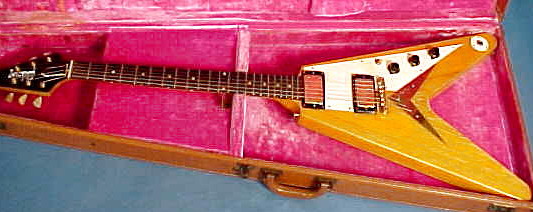
the time? How about the counterfeit Gibson Korina Flying "V"'s
and Explorers? I got stuck with one of those and I've owned
probably two dozen original Korina pieces.
Did that brown Les Paul case come with the vintage guitar you
bought or did you buy it later and put the two together? Is it
uncool to find a brown case from 1958 and stick your 1959 Les
Paul in it? Is your guitar just in extraordinary condition or
was it refinished 25 years ago?
I've walked around a guitar show and shown the same guitar to 30
different dealers. Without a doubt, I'd usually get 10 different
opinions. It was always the guy that was telling me the guitar
was re-finished who would change his story completely after he
bought the guitar from me. Then, the guitar became 100%
original. So, seeing how you can’t even trust the opinion of the
so-called experts some of the time, you have to ask yourself a
question: Is that 300 thousand dollar Les Paul you bought
completely original? Isn't that a little overspray I see behind
the 3rd fret? What if it boils down to dealer A's word against
dealer B's word? The people in this business are not trained at
Harvard. They are people and people make mistakes. Who are you
going to turn to with confidence when you need an expert
opinion? Before you answer that question I think you should know
that in the early 70's I spent a lot of time with the factory
repairman for Fender. He took a lot of damaged Fender Strats
sent in by customers and refinished them. I've seen these same
refinished guitars for sale at vintage shows as all original.
And you know what? They DO look all original. I just hope you
don't pay $50,000 for one!
4. There
is NO guarantee that vintage guitars will hold their value.
Let's face it. Vintage guitars are only desirable because
they have gone up ridiculously in value in the past few years.
If you manage to buy one, hold on to it and sell it for a
profit, you are apparently a wise man. When I started dealing
vintage guitars in the early 70's, I'd sell a rosewood board
from the 60's for $400 and a maple neck from the 50"s for $600.
Not too long ago I went to a show in Santa Monica and a vintage
dealer had 15 vintage guitars on display at a "Modernism" show.
Just what the guitars were doing there was a mystery to me.
Anyway, he had a really average '54 Strat on display and it was
tagged $100,000. He also had a nice white '65 Strat tagged
$50,000. I walked up and said, like a smartass: "Selling lots of
stuff?" He sort of hemmed and hawed and said: "Well, this is
just sort of an exhibition". I had to suppress my laughter. I
guess I'm supposed to believe that the guitars I sold as
recently as the mid 80's have appreciated 15000 percent? What's
wrong with this picture?
If you study collectables, (as you should, because vintage
guitars are nothing more than collectables), you will know
something about the other collectable markets. Baseball cards,
comic books, vintage cars, and other kinds of collectables will
give you valuable insight into what happens and CAN happen in
this volatile collector’s market place. Baseball cards and comic
books were really hot in the 1990's. There was a time when a
baseball card collector would send his best cards off to a
company that specialized in the careful determination of the
exact condition of a particular card, seal it in plastic,
certify it and charge plenty for this process. Well, the
baseball card market has taken a huge bath. Prices have dropped
dramatically. The cards now in some cases are worth less than
the cost of the appraisal process the dealer paid for. Comic
books have suffered a similar fate. No one is completely sure
why this happened. Some people think Ebay made the availability
too easy. Others think it was just a fad that got played out.
Ferraris that sold for a million dollars at one point in the
70's dropped to less than half that a few years later.
The vintage guitar market has done amazingly well. If you
charted it, it would be impressive. There have been huge gains
in value in the past ten years. I think that rock and roll and
the electric guitar have become cultural icons. What started as
a small club of geeks (myself included) grew exponentially and
caught fire all across America. Publicity about the auctioning
of guitars owned by rock stars became commonplace on television.
No other collectable can boast the success story of that of the
vintage American guitar. I wish I had held on to a few sunbursts
obviously, but only for one reason- so I could cash out on them.
I hate to be the Alan Greenspan of the vintage guitar world but
sorry ladies and gentleman, there is irrational exuberance afoot
in the vintage guitar world. You have to ask yourself a
question. Does the fact that the guitars have steadily risen in
price mean that they will always be going up in value? Is it a
good investment to buy a Les Paul for $300,000? Do you like to
buy stocks when they are cheap or when they are at their highest
ever recorded levels? Will a Les Paul be $500,000 in 10 years or
will it be $200,000? or $20,000? or less! The truth is that
vintage guitars will be a really good investment until they
aren't. That's about all you can say. It’s clear that the old
axiom of Supply and Demand is dictating that the prices must go
higher. The Supply is a finite and limited number. You never
have to worry that someone is going to find a secret stash of
one thousand pre-war D-45’s. However, Demand is the tricky part.
Right now, people are excited and the demand is relatively high.
People are willing to pay 3 months salary to buy a single pick
up, mahogany Les Paul Jr. You have to ask yourself a question-
Can I be sure that the Demand for these instruments will stay
high?
Do yourself a favor and Google the word Tulipomania.
5. How do you protect and insure a valuable vintage guitar
collection?
Okay, you have two sunbursts, a Broadcaster and a 1954 Strat.
You called your insurance man and told him that you own guitars
with a total value of $800,000.00. Yeah, he hung up on you a
couple of times until you finally convinced him you weren’t
prank calling him. After his secretary revived him with smelling
salts, he told you that he have to call the homeowners insurance
company and "check into it". After a couple of weeks of waiting,
you call the guy and he says "I can't get an answer". After two
more weeks, he calls you again and says: "We can’t do it". Next
you try a company that specializes in vintage gear. You get a
quote for $8000. However, the guitars are "only covered for
fire, theft or water damage". You are chagrined to discover that
if you manage to drop you Les Paul on the floor and break off
the headstock, you aren’t covered for that! You also aren’t
covered if the neck warps because you are afraid to take it out
of the case or if the top on your D-45 cracks because you forgot
to leave the air conditioning on in July when you went on
vacation. And don’t even think about picking them up and
strumming them! They are far too valuable and you have to
protect this $800,000.00 ! Unfortunately, unlike money in the bank,
your guitars take up space, are susceptible to damage, are
vulnerable to temperature and moisture and draw no interest
while they are sitting in your closet. And for God's sake, don’t
show them to anyone and don’t tell anyone you own them!
The safest thing to do is put them in a bank vault ($400 a
month) and just keep pictures of them at home that you can look
at!
6. Nobody Cares But YOU and a few other guys that haven’t
discovered girls yet!
Besides collecting vintage guitars, I've collected a variety of
interesting things over the years. I loved coins when I was a
kid. Stamps soon followed. Comic books and baseball cards were a
blast. Eventually, of course, you outgrow these things. One of
the last things I collected was vintage clothing- especially
rayon Hawaiian shirts from the 40's. I had a couple of mint
condition old shirts that I loved to wear on the rare occasions
when I felt like putting them on. It was always a kick in the
ass when I'd show up in my beautiful 1940's Duke Kahanamoku
shirt and people would have no reaction. I expected them to
think my hobby was as cool as I thought it was. Guess what?
Nobody cares!
Take your finest vintage guitar and walk up to a guy on the
street and show it to him. Don't expect him to start salivating
and scream at the top of his lungs "Oh my God, a vintage
guitar!". He's far more likely to think you are just weird and
say "Yes, your guitar is very nice; you'll have to excuse me now
as I have a girlfriend and we are going to be engaging in adult
activities".
Only the middle aged, amateur, unwashed musicians of the world
who happened to be familiar with the fact that you have an old
guitar will want to be your friend. Once again, you will have to
ask yourself a question- Do I really want to hang out with these
people? However, if you sell your guitars and put that
$800,000.00 in the bank, you will have tons of new friends!
(True True True So Very Very True)
7. There is too much of a disparity between wholesale and
retail value in the vintage guitar market.
The rules need to change now that vintage guitars have the
valuations that they do. What I mean by that, is if you are
paying a quarter of a million dollars for a guitar, you should
be confident that you can get your money back when you are ready
to sell it. Otherwise, it’s not really an "investment" at all is
it? No one who buys expensive fine art, jewelry or real estate
fears that they will lose half their money if they need to sell
quickly. The most dangerous thing about vintage guitars is that
they have very poor liquidity. When I owned my vintage store I
was very aggressive about buying. If I sold a guitar for a
thousand dollars, I would sometimes pay as much as $900 just to
get it. I was located in California at the time and prices here
were always high. But I’d travel to Dallas and Denver and other
parts of the country to buy at vintage shows and I noticed
something extraordinary. A lot of dealers would only pay 30 to
50 percent of the retail value of a guitar when they were
buying. They thought I was nuts. They would never buy anything
from me. For several years, in the early days, I was always the
biggest buyer at the Dallas guitar shows. I’d go there and drop
thirty thousand dollars and buy forty guitars and bring them
back to Los Angeles to retail them. The dealers in other states
were uncomfortable paying more than a small fraction of the
retail value of the guitars. The biggest dealer in the country
was buying very little, preferring to take most of his stock in
consignments. The shocker is that, for the most part, this still
remains true except that it has actually gotten worse. If you
buy a $10,000.00 Les Paul Junior (no comment) from a vintage store,
you have to ask yourself a question. How much did your smiling
vintage guitar store owner pay for it? I’ll tell you. He paid
about $6000.00 or less. That’s assuming he has the balls to
actually buy the guitar in the first place. Many dealers will
only buy something they have pre-sold or will only take
expensive guitars on consignment. Many of these stores can’t
afford to sit on inventory of hundreds of thousands of dollars.
Guess what he’s going to offer you for that same guitar when you
need the money. He may offer you $6000.00 if he has a buyer but
chances are he will tell you to put it on consignment for a year
and he will still charge you 20% to sell it on that basis. It’s
my personal belief that when I see an extremely expensive guitar
for sale online or at a vintage store, it’s a safe bet that the
owner paid no where near what he is trying to sell it for. The
smart sellers will cash out before the masses do. I pity the
chump that paid a huge amount of money and is calling the
vintage store every day to find out if they found a buyer yet.
Sure, if you paid $6500 in 1985 for a sunburst, you aren’t
particularly worried about selling your guitar. But how about
the guy that paid $250,000.00 and is frantic to get his money
back? The truth is that at these prices, the difference between
wholesale and retail should be at most 10 to 20 percent. I sell
real estate and I make anywhere from one to two and a half
percent when I sell something. Why such a small percentage?
Because 1 to 2.5 percent of a million dollars is still a lot of
money. Don’t expect your local vintage store to agree with me on
this point. I’m sure that their attitude is: 1. Let the Buyer
Beware. 2. It’s the American way to make as much money as you
possibly can. 3. Don’t wade into the deep end if you can't swim.
The truth is that vintage guitars are only worth what a five day
auction on Ebay will net the seller. How come you never see any
1959 Les Paul Standards being auctioned on Ebay? It’s because
they will sell for about 30% of what your vintage guitar seller
is asking for them. Just keep in mind genius, that the ACTUAL
value is the Ebay value. Not some super inflated BS value that
Joe guitar dealer came up with.
If you buy real estate and after a year sell it, are you going
to lose 40%? If you buy Microsoft stock or a CD or a bond are
you going to lose 40%? The sad reality is that DEALERS are
controlling this market, not end buyers. I'll bet that most
sales are occurring between dealers. It works like this: Dealer
"A" has lunch with some industrialist, wealthy celebrity, rock
star or whatever. Dealer "A" explains what a great "investment"
this $80 Les Paul Junior is at a mere $10,000.00. Trusting sap
gives $10,000.00 to Dealer "A". Dealer "A" realizes he could
have gotten another $1000 out of trusting sap, so he calls up
Dealer "B" and asks for another $80 Les Paul Junior that he can
sell on consignment to trusting sap. Multiply that scenario a
couple thousand times and you get a $500,000.00 Les Paul
Standard Sunburst!
There's something else you should know, especially if you are
new to the vintage guitar hobby. The stuff they sell as
"vintage" in the stores today is for the most part CRAP. If I
had to make a living selling the ugly, modified, hideous guitars
these guys are hawking today, I'd have gone out of business. I
look up at the guitars on the walls of the vintage guitar stores
now and I see AWFUL 1970's Fender guitars tagged $10,000.00! If
they have a Strat from the 60's, the pickguard is changed, the
neck is oversprayed, and it has an elbow mark on the face the
size of a cantaloupe! This stuff is JUNK! You'll never convince
me that it's a good investment! If some dealer wants $75,000 for
an original '52 Telly, that doesn't mean a refinished one with
changed pick-ups is worth $35,000!! A refinished one with changed
pick-ups is RUINED! It's JUNK. Outside of a re-fret or a tuning
peg change, modifications should mean YOU DON'T BUY THE GUITAR!!
And remember this, and you can tell your vintage guitar dealer I
said so, NOTHING MADE AFTER 1969 IS A COLLECTABLE. Call me a
purist but the guitars that Fender and Gibson and others made
after 1969 are for the most part, not worth owning unless you
are just paying "used guitar" money. Which is about 1/2 to 1/3
of today's retail!
So you have to ask yourself a question: How good of an
investment is a vintage guitar? If you buy one now and have to
sell it soon, are you still going to make money?
8. Is a guitar more valuable because a celebrity owned it?
This is a good question. Clearly celebrity is currently the most
valuable commodity in America. If you are Paris Hilton or
Britney Spears or Lindsay Lohan, you could probably get away
with murder and people would still ask for your autograph. But
the whole issue of celebrity owned guitars is very interesting.
There is no arguing that if you bought one of Eric Clapton’s
three hundred dollar Japanese Strats at that art house auction
for $50,000, you believe that celebrity is important. However,
as we all know, fame is fleeting. The famous heroes of today
have a terrible habit of doing something ghastly and then they
change from famous to notorious in a heartbeat. Unquestionably,
the O.J.’s, Robert Blake's, and Michael Jackson's of the world
were far more admired at one time than they are now. It’s also
true that to lose your fame, you really don’t have to do much
other than fall out of the public eye for a few years. So, once
again you have to ask yourself a question- Is that Strat I
bought for 50 large only going to be valuable as long as the
celebrity that played it is still famous and admired? The answer
is obvious. If you buy a celebrity guitar and the celebrity
fades away or worse yet, gets into trouble, what happens to your
investment? I know what you are going to say. You are going to
say that "it doesn’t matter as long as you enjoy it while you
have it." Actually I totally agree with that sentiment. The only
caveat is that you had better be ready to hold on to that
attitude if your celebrity guitar turns out to be worthless 10
years later. I’m sure there was a time that Rudy Vallee’s
megaphone could have been sold for a whole lot of money. Who is
Rudy Vallee you ask? Well, that’s my whole point!
9. Guitars are just tools.
For the life of me, I don't understand how the focus somehow
shifted from the man playing his guitar to the guitar itself. A
guitar in the hands of a novice is not exactly a pleasant
experience for the listener. It's best to learn guitar in your
bedroom with the door shut behind you. Once someone has become
an accomplished musician, the guitar can be a joy to listen too.
It is truly a versatile, beautiful sounding instrument. This
fact seems to be lost on the vintage guitar collector.
Collectors frequently can't play worth a damn. The guitars are
wasted on them. It's not about making music or learning to play;
it's about hoarding a valuable commodity. You can only play one
guitar at a time. You don't need 400 of them sitting in a
warehouse. Investing is not my idea of fun. I've never seen a
group of investors get together to compare portfolios and show
off their accumulated wealth. I'd much rather play a guitar than
look at one. I LOVE playing guitar with my friends. Yes, I've
had guys come over to my house to show me their wonderful old
guitar, but for the most part, those guys were always single and
compulsive masturbators. Inevitably, I'd have to ask them to
check on their car because "I thought I heard glass breaking"
and when they'd run outside, I'd lock the door behind them.
Guitars are just tools for making music. It's too bad they got
turned into something else. No one collects the computers that
writers write books with or the paint brushes that great artists
paint great paintings with. Why would anyone want to hoard an
old guitar? I don’t get it. I'm really pissed off that somebody
ruined my hobby! People should own an instrument that they can
afford and aren’t afraid to play. You don’t need a 1954 Strat to
play good music. It's not the guitar itself that is the
important thing. The important thing is to learn to play and
enjoy yourself doing it.
10. So what are vintage guitars really worth?
I think that if you examine the collectables market you will see
certain trends in pricing. You can trace trends in baseball
cards, pogs, coins, comic books, vintage autos and the like.
Interestingly, the auto market, certain models have seen spikes
in popularity for a few years but most level off at some point.
However, if you allow for inflation, you will note that almost
no vintage car of any make or manufacture will sell for more
than 4 or 5 times it’s original value. In many cases,
beautifully restored cars from the 30’s and 40’s will sell for
as little as twenty or thirty thousand dollars. The demand just
isn’t there. The intrinsic value of a collectable ultimately
will keep it’s valuation reasonable given enough time. Some
items are extremely faddish like pogs or Pokemon cards and enjoy
brief popularity and value. As the fad catches on, and more
people participate, the demand rises and the prices will too.
But the nature of fads is that the great majority of the
participants eventually lose interest causing the value to drop.
Currently the vintage guitars are at their peak of popularity
and seem to be leveling off. So you have to ask yourself a
question- At what point can you set a value that will hold? My
answer is that like so many other collectables, especially the
pricey ones, vintage guitars will eventually sell for 4 or 5
times their original cost allowing for inflation. Which by my
calculation is about 90 percent cheaper than they are now.
Anyone who thinks I’m crazy should chart the NASDAQ about the
time of the end of the bubble when many stocks priced at $250
dropped down to penny stock valuations. This is my humble
opinion and of course, I could be wrong. However if history
shows us anything at all, it shows us that a big market
correction is as likely to happen eventually as a further
appreciation in value. I know what you are thinking- awww this
chump is just talking sour grapes because he was too stupid to
keep a bunch of vintage guitars when he had the chance. I’d love
to rationalize that statement BUT I CANT! I wish like hell that
I’d kept a bunch of the things I’d sold- Elvis’s guitar, Jimi
Hendrix’s guitar, about a hundred sunbursts! But hindsight is
always 20/20. I moved on a long time ago and found an excellent
job and made a lot of money. The truth is, I could afford just
about any vintage guitar including a 1959 Les Paul sunburst. But
when I see what has happened to vintage guitars, it just seems
hilarious. I have no problem taking Nancy Reagan’s advice- I
just say no. When the day comes that I can buy a 50’s Les Paul
for five or ten thousand dollars, I might do it. But I’ll be
buying it because it’s beautiful, it’s old, it’s fun to play and
I’m enjoying it. I’m not buying it because "it’s a good
investment"! Personally, in my humble opinion, I think
collectables should never sell for more than four or five times
what a new version of the same object is selling for. If you can
by a perfect copy of a '54 Strat from Fender for $2000.00, I
think $8000 to $10,000 for the real thing is realistic and
appropriate and safe. Feel free to write to me and disagree. I'm
going to print every response I get as a reply to a question
here on Ebay.
Frank Lucido
Studio City, CA.
|