Tilia americana
Correct Pronunciation Phonetically is Baahsswood
Some people tend to pronounce it Base-wood (That Is Wrong)
The name comes from its inner bark, or bast, used by American Indians to make
rope.
I'm not a big fan of Basswood, It's
boring looking and isn't especially good for any type of particular tone.
Very very Inexpensive it is used by many companies as a cheap substitute for
Alder.
Schecter, ESP, Jackson, Yamaha, Peavey, Epiphony, and the rest of the
corporate geeks.
You can dent it with your fingernails. and it has zero personality.
Blandwood might be a better name!!
Fun Facts To Know
If you are at a party
with a bunch of gorgeous women and the subject of "Wood" comes up. you could
really be Joe Cool if you knew some of these fun facts below.
Principally the Northern and Lake states. Average
tree height is 65 feet.
Main Uses
Carvings, turnings, furniture, pattern-making, moldings, millwork and
guitars. An important specialized use is Venetian blinds & shutters.
Relative Abundance
Together, aspen, basswood, cottonwood, elm, gum, hackberry, sassafras,
sycamore and willow represent 12.5 percent of commercially available U.S.
hardwoods.
 Did
You Know? Did
You Know?
Native Americans also used basswood’s inner bark fibers to make thread and
fabric.
General Description
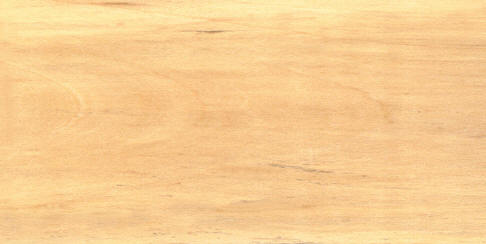
The sapwood of basswood is usually quite large and creamy white in color,
merging into the heartwood which is pale to reddish brown, sometimes with
darker streaks. The wood has a fine uniform texture and indistinct grain
that is straight.
Working Properties
Basswood machines well and is easy to work with hand tools making it a
premier carving wood. It nails, screws, and glues fairly well and can be
sanded and stained to a good smooth finish. It dries fairly rapidly with
little distortion or degrade. It has fairly high shrinkage but good
dimensional stability when dry.
Physical Properties
The wood is light and soft with generally low strength properties and a poor
steam-bending classification.
Availability
Reasonable abundant and cheap.... That's why the big corporations use it.
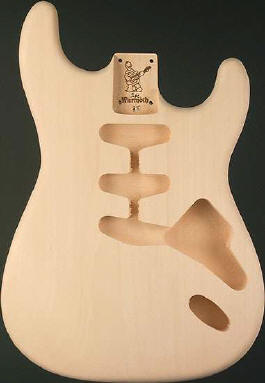
The Strat body is a Warmoth.
|
|
Basswood
Several [Fender] Japanese reissue models use Basswood [as body material].
Produces a light (body wt less than 4 lb.) guitar though some people find
the sound to be too "dark". Basswood is a very soft wood and cannot handle a
lot of abuse.
Ideal for loud high gain tones [when used as body material]. The sound is
smooth, without many sharp edges. Attack is moderate and sustain is round
and even.
For a solid color guitar it is one of the better woods. It is used by
many well known large manufacturers. It comes from Northern U.S.A. and
Canada. It costs less than dirt that's and it
does the job.. Thats why the big corporations love it.
This is a lighter weight wood offering Strat bodies usually under 4 lbs.
The color is white, but often has nasty green mineral streaks in it. This is
a closed-grain wood, but can absorb a lot of finish. This is not a wood for
clear finishes, and it is quite soft, not good for much abuse. Sound wise,
Basswood has a warm tone.
Strong Midrange, balanced tone and light weight. Light color and almost
no grain patterns Basswood is best suited for solid colors or is excellent
as a backing wood for a maple top.
|
|